
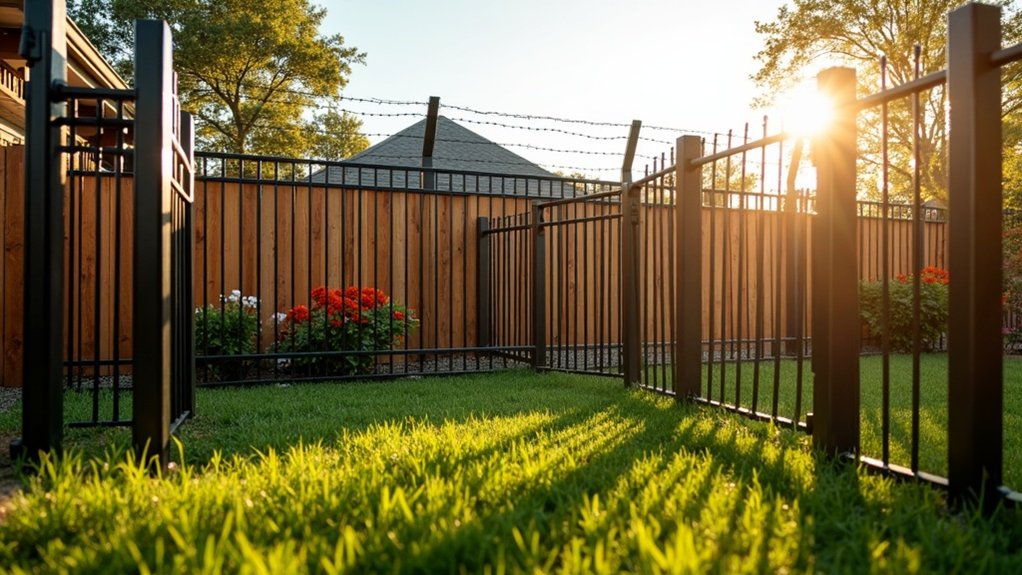
To select the right height for your security fence, first check local regulations—typically, residential fences must be at least 4 feet tall, while commercial ones need to be at least 6 feet. Consider the specific threats to your property and the value of your assets to gauge your security requirements. Keep in mind that fences over 6 feet may need special zoning permits. Striking a balance between height, visibility, and materials can boost security while still looking good. For more tips, keep exploring this topic.
Key Takeaways
- Check local regulations for the minimum and maximum fence height allowed for your property type and area.
- Assess the level of threat and the value of what you’re protecting to determine the right height for security.
- For residential properties, a fence height of 4-6 feet is typical, while commercial and industrial properties may need 6-10 feet.
- Choose materials wisely; steel offers high security, while wood provides privacy.
- Don’t overlook aesthetics; ensure the fence height and design enhance your property while still keeping it secure.
Understanding Security Fence Height Requirements

When choosing the height for a security fence, consider the following factors:
1. Local Regulations: Different areas have varying height restrictions. Always check local laws before installation.
2. Property Type:
- Residential properties typically require a minimum height of four feet.
- Commercial properties usually benefit from a six-foot fence.
- For industrial sites, opt for heights between eight to ten feet, often with additional deterrents like barbed wire. A minimum height of 6 feet is recognized for effective security in commercial properties.
3. Material and Topography: The type of material you choose can affect how tall a fence can be built.
Also, consider the land’s slope; measure from the finished ground level to ensure compliance.
Ultimately, finding the right balance between fence height and type is crucial for effective security and maintaining visual appeal.
Assessing Threat Levels for Your Property

To effectively assess the threat levels for your property, start by identifying potential risks such as natural disasters, crime, and insider threats.
Conduct a risk assessment using methods like threat-based and vulnerability-based evaluations to determine which threats are most relevant to you. Use a risk matrix to categorize each threat by its likelihood and potential impact, helping you prioritize your mitigation efforts. Additionally, remember that risk management is a crucial process for mitigating vulnerabilities and reducing risk.
Consider external factors like local crime rates and environmental conditions that may increase risks.
Evaluating the Value of Your Assets

To choose the right height for your security fence, start by evaluating the value of your assets. For example, if you own expensive equipment or valuable inventory, consider investing in a taller fence for better protection. This assessment helps you balance potential risks with the costs of security measures. Understanding the value of your assets is crucial in determining the level of security needed to safeguard them effectively. Additionally, taller fences can incorporate advanced security features that enhance protection against intrusion.
Asset Worth Assessment
Accurate asset worth assessment is crucial for effective decision-making in personal and business scenarios. Knowing your assets helps set the right security measures.
Here are some key points for asset valuation and liability assessment:
- Differentiate between tangible assets (like machinery) and intangible assets (like patents) for accurate valuation.
- Classify assets into categories, such as current (cash, inventory) and fixed (buildings, equipment), for better risk evaluation.
- Use the adjusted net asset method to determine fair market values.
- Assess high-value items for their risk of theft or damage from environmental factors.
Risk vs. Value Analysis
Conducting a risk vs. value analysis is crucial for effective security planning. Begin by assessing risks: determine how often threats occur and how vulnerable your assets are.
Use the formula: Risk = Threat Frequency × Vulnerability × Asset Value to rank your assets by importance to your operations. High-value assets should have stronger protections since their compromise could have significant consequences.
Classify your assets as high, medium, or low value, taking into account their financial and strategic importance. This organized method helps you prioritize effectively and allocate resources where they matter most.
Don’t forget to consider less obvious assets, as neglecting them can lead to vulnerabilities. A thorough risk evaluation is essential for making informed decisions about security measures, like determining the appropriate height for security fences. Additionally, understanding the functionality of fencing can further enhance your security strategy.
Considering Property Type and Usage

When selecting the height for your security fence, consider your property’s type and usage.
For residential areas, aim for a height that balances privacy and security.
In commercial spaces, taller fences are often necessary for better protection.
Industrial properties usually require fences over ten feet high due to stricter security needs.
Always tailor your choice to fit the specific requirements of your property. Additionally, keep in mind that homes without security systems are 3x more likely to be targeted, emphasizing the need for effective fencing solutions.
Residential Security Needs
To determine the right height for your security fence, consider these key factors:
- Property Type: For single-family homes, a height of 6 to 8 feet is typically effective.
- Usage: If you have a pool, a minimum 4-foot fence is required, but taller options provide added security.
- Crime Rate: In areas with higher crime rates, fences over 8 feet may offer better protection.
- Maintenance: Choose materials that are durable and low-maintenance to ensure long-lasting security.
These considerations will help you find the right fence height for your residential security needs.
Commercial Property Considerations
Choosing the right height for a commercial security fence is crucial and depends on the property’s type and usage. Here’s a quick guide:
| Property Type | Recommended Fence Height |
|---|---|
| Retail Stores | 6 to 8 feet |
| Office Complexes | 6 to 8 feet |
| Restaurants/Entertainment | 6 feet |
| Medical/Educational Facilities | 6 to 8 feet |
| Warehouses/Distribution Centers | 8 to 10 feet |
For example, retail spaces need lower fences for visibility and customer engagement, while warehouses require taller fences to protect valuable inventory. Always check local regulations and assess specific security risks to determine the best fence height that balances security and aesthetics.
Industrial Site Requirements
Industrial site requirements can vary, but choosing the right fence height is crucial for security. Here are some key points:
- Start with a minimum height of 8 feet to deter intruders.
- For higher-risk areas, consider 10 feet or more, possibly with barbed wire.
- Sites with valuable assets may need fences of 12 feet or higher.
- Be aware of local regulations that might limit maximum heights.
Ensure your fence is durable and visually appealing to match your site’s character.
Always consider operational needs while following safety and zoning codes.
Local Building Codes and Zoning Regulations

Before installing a security fence, familiarize yourself with local building codes and zoning regulations.
These rules specify the maximum heights and placement of fences. For most residential areas, side and rear yard fences can be up to 6 feet tall, while front yard fences are typically capped at 4 feet.
If you plan to exceed these limits, you may need to apply for zoning variances or special permits. It’s crucial to comply with these regulations to avoid fines or even the forced removal of your fence.
Also, ensure your fence design meets clear sight triangle standards near driveways or intersections to keep everyone safe and visible.
The Impact of Visibility on Fence Height

The height of a fence is significantly influenced by its visibility, which is crucial for effective security.
Here are some key points to consider:
- Fences that are highly visible, like chain link, often need to be taller (8 ft or more) because they can be climbed easily.
- Privacy fences, which are less visible, should also be tall (6-8 ft) to effectively block views.
- A balance of height and moderate visibility can deter intruders while still allowing for monitoring.
- Clear sightlines are essential for surveillance and electronic monitoring.
Material Choices and Their Influence on Height

The height of security fences depends heavily on the material used. For instance, steel fences can go up to 10 feet, making them excellent for security, especially with added features like barbed wire.
Wrought iron provides a good mix of strength and looks, typically standing between 6 to 8 feet. Aluminum, while lightweight and resistant to rust, usually caps at 6 or 8 feet, which may not suffice for high-security needs.
Wood and vinyl fences focus on privacy and generally stay at 6 to 8 feet, needing extra support for heights above 6 feet.
In short, the material you choose significantly impacts the effective height of your security fence.
Designing for Security: Deterrents and Reinforcements

To boost security, integrate effective deterrents and reinforcements into your fence design.
Here are some key elements to consider:
- Barbed or razor wire at the top makes climbing difficult.
- Spikes or electronic sensors help detect intrusions early.
- Concrete curbs or bottom rails anchor the fence firmly.
- High-tensile mesh resists forced entry.
These features not only create a strong physical barrier but also deter potential intruders psychologically.
Measuring and Installing Your Fence Correctly

When measuring and installing your security fence, it’s crucial to get the height right for maximum effectiveness.
Keep in mind the terrain, as it can impact both installation and the fence’s look.
If you’re unsure about the process, hiring a professional can really help ensure your fence is both secure and visually appealing.
Accurate Height Measurement
Accurate height measurement is crucial for ensuring your security fence is effective and meets regulations.
Here are some straightforward tips for precise measurements:
- Start measuring from the finished ground level where the fence posts touch the ground.
- Measure straight up to the highest point of the fence, ignoring any part buried underground.
- Use a level tool to make sure the fence is completely vertical.
- Take several measurements along the fence to account for uneven ground.
These steps will help ensure your fence is properly installed and functional.
Terrain Considerations
Understanding the terrain is crucial for effectively measuring and installing your security fence. Start by assessing the slope gradient to decide between a stepped or racked installation.
A topographic survey helps you outline boundaries and spot obstacles like rocks and trees. Check the soil type, as it affects how deep you need to anchor the posts for stability.
Ensure your fence height is consistent with the terrain to maintain security. For sloped areas, use reinforced posts to prevent erosion.
Don’t forget to check local building codes that may dictate fence height and design based on the terrain, ensuring your installation is both compliant and secure.
Professional Installation Tips
To ensure your security fence is installed properly, follow these key steps:
- Confirm your property boundaries to prevent disputes.
- Check with utility companies before digging to avoid damaging underground lines.
- Measure post distances, usually 8 feet apart.
- Use a carpenter’s level to ensure posts are vertical.
When digging post holes, make sure they’re the recommended depth.
Add gravel for drainage and brace the posts while the concrete cures.
Use a string line to align panels for a uniform look, and secure them with the right fasteners.
These steps will make your fence installation more efficient and effective.
Balancing Deterrence and Surveillance

While a taller fence can boost security by making unauthorized access harder, it’s important to consider how height impacts surveillance. Finding the right balance between deterrence and visibility is crucial for effective security.
| Fence Height | Deterrent Effectiveness | Surveillance Capability |
|---|---|---|
| 6 feet | Moderate | High |
| 8 feet | High | Moderate |
| 10 feet | Very High | Low |
| 12+ feet | Maximum | Very Low |
Fences between 6 and 8 feet offer a good balance. They allow for effective surveillance technology while still providing strong deterrence. Using transparent materials alongside height can further enhance both security and monitoring, ensuring comprehensive protection.
Aesthetic Considerations for Security Fences

A well-designed security fence not only protects your property but also boosts its visual appeal.
Here are key considerations for choosing an aesthetic security fence:
- Material and Finish: Choose sturdy materials that match your property’s style, like wood for a rustic look or metal for a modern vibe.
- Height Options: Think about how the height impacts security and visibility. Taller fences offer more security, while shorter ones can feel more welcoming.
- Style Variations: Look for designs that combine beauty and function, such as decorative ironwork or sleek, minimalistic styles.
- Integration with Landscaping: Position your fence to complement existing plants and trees, making it blend seamlessly with your outdoor space.
Frequently Asked Questions
Can I Paint My Security Fence a Different Color?
Yes, you can paint your security fence a different color, but be sure to check local regulations and any HOA rules. For example, if your neighborhood has a specific color scheme, you may need to stick to those guidelines to maintain a cohesive look. Additionally, consider how the color affects the fence’s security perception; bright colors might not convey the same sense of safety as darker shades.
How Do I Maintain My Security Fence Over Time?
Treat your security fence like a guardian. Regularly inspect it for issues, such as rust or loose panels, and fix any damage promptly to keep it strong. This simple routine helps ensure your fence remains a reliable defense against threats over time.
What Are the Best Materials for a Security Fence?
For a security fence, metal is a top choice due to its strength and ability to withstand impacts. Vinyl is another good option, as it requires little maintenance and resists weather damage. While wood can look nice, it needs more care than metal or vinyl.
Are There Eco-Friendly Options for Security Fencing?
Yes, eco-friendly security fencing is available. Consider options made from recycled wood, composite plastics, or metal. Look for green certifications to ensure they meet environmental standards and contribute to sustainability.
How Long Does It Take to Install a Security Fence?
Installing a security fence usually takes between 1 to 5 days. Factors like the type of terrain and materials can affect the timeline, so it’s important to plan ahead for a smoother installation. For example, rocky ground might slow things down, while flat land could speed up the process.
Conclusion
Choosing the right height for your security fence is crucial for protection. Assess your specific security threats and your property’s needs to find a height that deters intruders while allowing visibility. For example, a 6-foot fence can be effective for residential areas, while a taller 8-foot fence might be better for commercial properties. Don’t forget to consider local regulations. By finding the right balance between security and aesthetics, you can ensure your fence is both effective and visually appealing.
Boost your home security with effective residential fencing solutions that not only protect your property but also enhance its appeal—discover Read more
Navigate the world of anti-climb fence options for high-security zones and discover why the right choice is crucial for protecting Read more
Find the perfect security fencing solutions for your property that combine style and strength; discover how to protect your space Read more


